


The statutory audit of accounts for SRLs represents one of the most significant safeguards in our corporate legal system. Understanding exactly when the obligation to appoint a statutory auditor is triggered is essential not only to avoid penalties, but also to plan an adjustment process in time that protects directors, shareholders, and stakeholders.
In this in-depth analysis, we examine the thresholds set by Article 2477 of the Civil Code, cases of automatic obligation, and the consequences of non-compliance.
The regulatory framework: Article 2477 of the Civil Code
Article 2477 of the Civil Code, as amended by the Business Crisis and Insolvency Code (Legislative Decree 14/2019 and subsequent amendments), governs the obligation to appoint a control body or statutory auditor in limited liability companies (SRLs).
The regulation identifies three distinct conditions which, if met, make the appointment mandatory:
- Obligation to prepare consolidated financial statements;
- Control of a company that is itself required to undergo a statutory audit of accounts;
- Exceeding the size thresholds set by the regulation.
Size thresholds: when the obligation is triggered
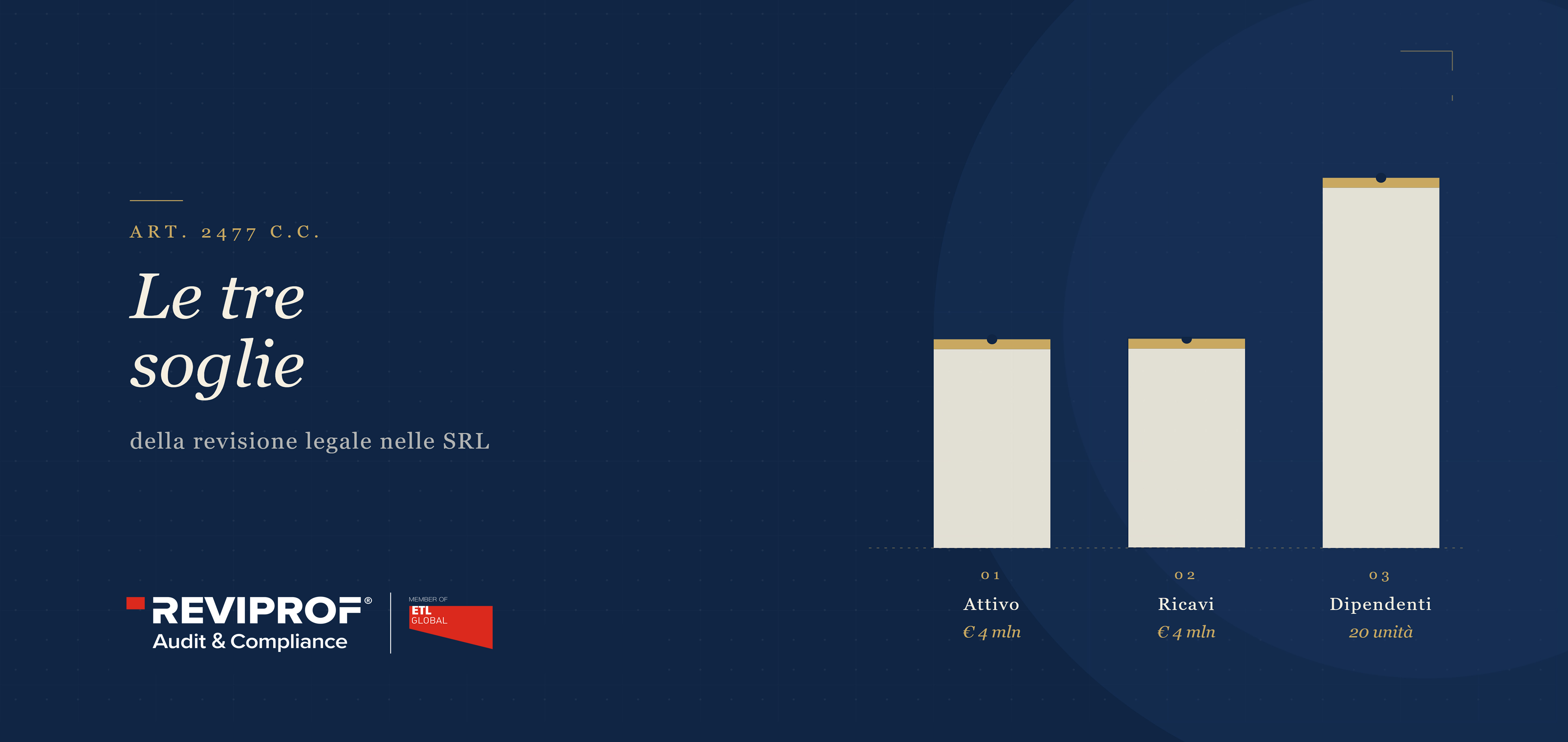
The appointment obligation is triggered when the SRL has exceeded at least one of the following limits for two consecutive financial years :
- Total balance sheet assets: 4 million euros;
- Revenue from sales and services: 4 million euros;
- Average number of employees during the financial year: 20.
A common misconception
It is important to emphasize that exceeding even just one parameter for two consecutive financial years is enough to trigger the requirement. It is not necessary to exceed all three thresholds simultaneously: this is a common misunderstanding that exposes many limited liability companies (SRLs) to the risk of penalties.
When the requirement ends
The obligation to retain a statutory auditor or control body ceases only when none of the three thresholds have been exceeded for three consecutive financial years. This rule is intentionally asymmetrical compared to the activation criteria: the legislator intended to ensure continuity in oversight, avoiding changes due to normal fluctuations in the parameters.
Cases of automatic obligation: when thresholds do not matter
There are situations where the appointment requirement is triggered immediately, without waiting for the thresholds to be exceeded for two years. These include:
- SRLs required to prepare consolidated financial statements;
- SRLs that control a company which is itself required to undergo a statutory audit;
- Companies subject to supervision by authorities such as the Bank of Italy, IVASS, or CONSOB;
- Limited liability companies (SRLs) that have issued financial instruments distributed among the public.
In these cases, the appointment must be made as soon as the requirement is met.
Statutory auditor, control body, or both?
One of the aspects that causes the most confusion concerns the choice of configuration to adopt. The SRL can opt for:
- A sole statutory auditor (an individual registered in the Register of Statutory Auditors) or an audit firm;
- A control body (sole auditor or board of statutory auditors) which, if provided for by the articles of association, may also be entrusted with the statutory audit;
- The coexistence of a control body and a statutory auditor, with a separation of supervisory and auditing functions.
The optimal choice depends on the governance structure, corporate balance, and internal control objectives. For a personalized analysis, it is advisable to consult with a professional.
Consequences of failure to appoint
Failure to comply with the appointment obligation exposes the company and its directors to significant consequences:
- Ex officio appointment by the Court, upon notification by any interested party or the Registrar of Companies;
- Civil liability of directors for any damages resulting from the omission;
- Reputational impact and potential disputes from banks, minority shareholders, and contractual counterparties;
- In more serious cases, potential liability issues in the event of a business crisis, in light of the strengthened duty to implement adequate organizational structures.
Why it pays to comply early
Waiting until the exact moment the obligation becomes mandatory is a risky strategy. Appointing a statutory auditor requires:
- Lead time to select the professional or the audit firm;
- Adjustment of accounting processes and internal controls to comply with ISA Italia auditing standards;
- Preparation of documentation necessary for the engagement and the first financial year subject to audit.
Complying early allows you to manage the transition smoothly, avoiding a last-minute rush and taking the opportunity to strengthen the quality of financial reporting, with tangible benefits for credit access and credibility with stakeholders.
Voluntary auditing: a strategic asset
Even when not required by law, many SRLs choose voluntary statutory audits as a tool for transparency and competitiveness. The benefits are tangible:
- Certified financial statements that facilitate access to bank credit;
- Greater reliability in the eyes of investors, strategic suppliers, and business partners;
- Reduced risk of material errors and tax disputes;
- Strengthened internal governance.
Conclusions
The requirement for statutory audits in SRLs is not merely a bureaucratic formality, but an essential component of sound corporate management. Checking your status against the thresholds of Art. 2477 of the Italian Civil Code in a timely manner—and acting in advance—means protecting your business and enhancing its reputation.
Do you have questions about the appointment requirement for your SRL?
The REVIPROF team supports limited liability companies in verifying their requirements, selecting the most efficient configuration, and executing audit engagements in accordance with ISA Italy standards.
Request a dedicated consultation →
